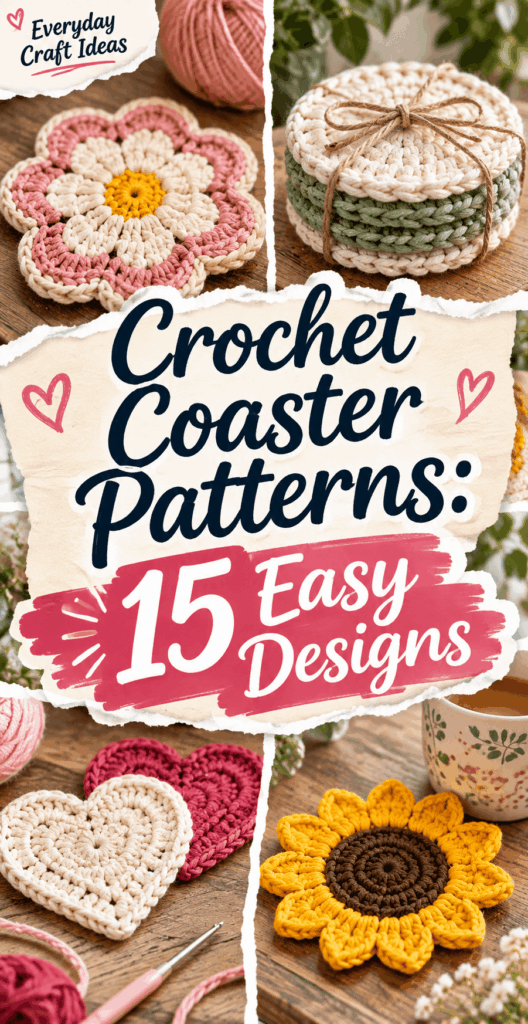
Crochet Coaster Patterns: 15 Easy Designs
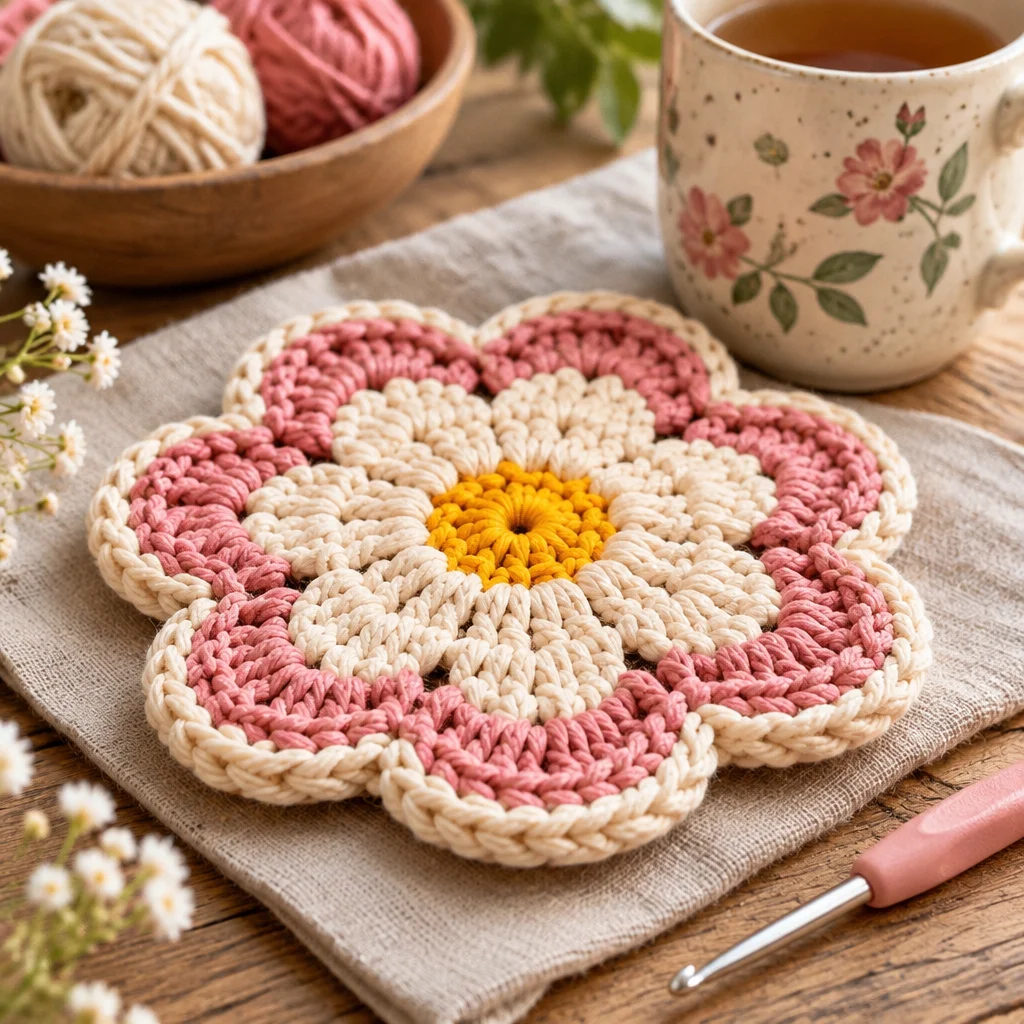
When you search for crochet coaster patterns, you usually want two things: designs that look cute on a table and instructions that actually work for beginners. Coasters are one of the fastest crochet wins because they are small, forgiving, and easy to customize with color and texture. In this guide, you will learn how to choose the right yarn and hook, how to keep your coasters flat, and how to finish them so they survive real life use (hot mugs, iced drinks, and frequent washing). I am also sharing 15 easy design ideas you can make with basic stitches, plus practical troubleshooting for the most common coaster problems.
Why This Project Is Worth Making
Crochet coasters are a practical project with a big payoff: you get something useful for your home, quick gifts, and a low-pressure way to practice consistency. Most crochet coaster patterns work up in 20 to 45 minutes each once you know the rhythm. Beginners can complete a simple single crochet or double crochet coaster in under an hour, and a set of four makes a satisfying weekend project.
Cost is low because coasters use small amounts of yarn. Even if you buy a new ball of cotton, you can often make 6 to 12 coasters from one skein depending on size and thickness. Difficulty is typically beginner to advanced beginner: you will practice chaining, working in the round or in rows, and finishing neatly. If you can make a chain and a single crochet, you can make a coaster.
This project suits:
- New crocheters who want repetition without committing to a blanket.
- Gift makers who need attractive, useful sets for teachers, neighbors, and hosts.
- Scrap yarn users who want to turn leftovers into something cohesive.
Best of all, coaster-making teaches skills that transfer directly to bigger projects like baskets, potholders, and market bags.
Supplies, Materials, and Beginner Setup
You can make most crochet coaster patterns with a small, simple kit. Start with what you have, then upgrade as you learn what you like. Here is a practical setup that works for nearly every coaster style:
- Cotton yarn (worsted weight): Cotton grips moisture and holds up to washing. A single 50 g to 100 g ball is plenty for multiple coasters.
- Hook (4.0 mm to 5.0 mm): Match it to your yarn label, then adjust for drape and thickness.
- Scissors: Sharp, small scissors make clean ends that weave in neatly.
- Tapestry needle: Essential for weaving in ends securely so your coaster does not unravel.
- Stitch marker (optional): Very helpful for rounds, especially for spiral rounds in single crochet.
- Measuring tape or ruler: Keeps sets consistent in size.
Budget substitutions: No stitch marker? Use a scrap of contrasting yarn. No tapestry needle? In a pinch, carefully use a small safety pin, but a needle is worth buying.
Safety note: Coasters are not trivets. Even thick crochet can trap heat. Use them under mugs and glasses, not under pots or very hot pans.
Why cotton yarn works best
If you want coasters that behave like coasters, cotton is your best friend. In most crochet coaster patterns, cotton helps in three important ways: it absorbs condensation, it tolerates heat from warm mugs better than many synthetics, and it stays stable through washing.
Concrete examples: A smooth worsted cotton like Lily Sugar’n Cream or Paintbox Cotton Aran makes sturdy, everyday coasters. A softer cotton like Dishie or a cotton bamboo blend creates a slightly smoother feel, great for delicate glassware. For a “spa” look, try mercerized cotton, which gives crisp stitch definition for textured patterns like waffle or front post stitches.
Realistic constraints: Cotton can feel stiff at first, especially in tight stitches. That is normal. After washing and drying flat, it relaxes. Also, cotton can shrink a bit in hot water, so wash your whole set the same way to keep sizes consistent.
What about acrylic? Acrylic is fine for decorative coasters that will not face heavy condensation, but it can feel “slick” and may not absorb moisture well. If you do use acrylic, choose textured stitches and a tighter gauge so the coaster feels substantial.
For the most functional results, pick cotton, keep your stitches even, and aim for a coaster thickness that feels protective but still dries quickly.
Round, square, granny-square and textured coasters
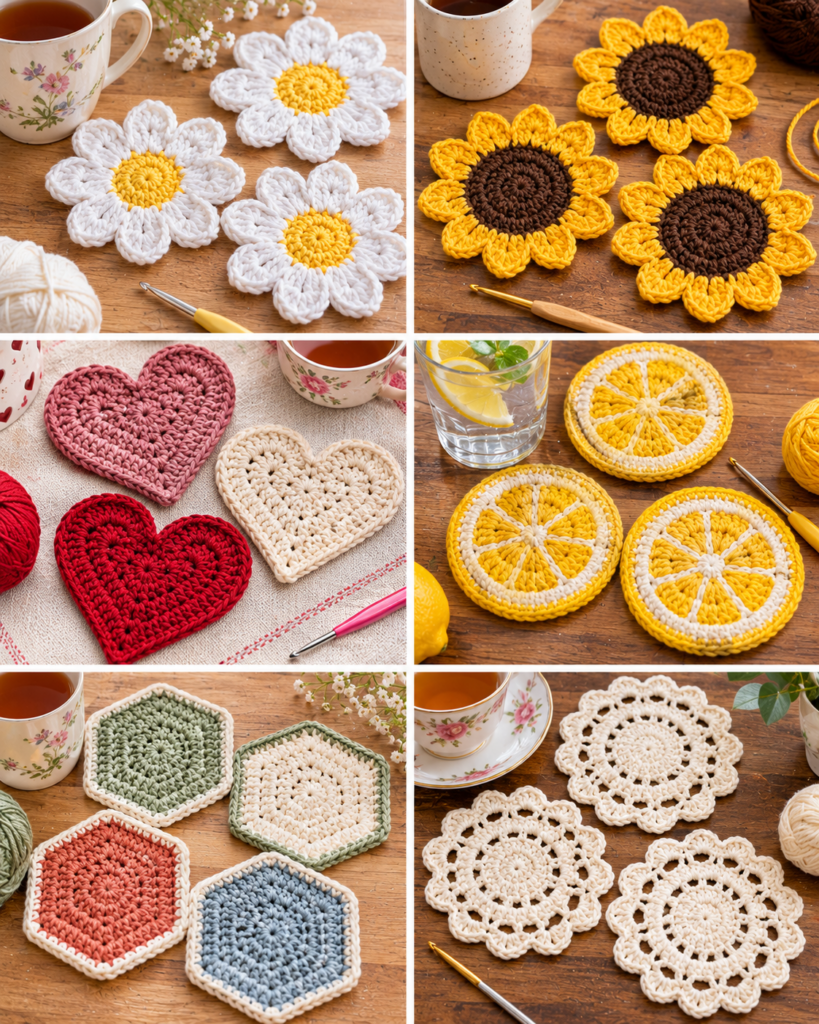
Here are 15 easy crochet coaster patterns you can make using basic building blocks. These are “design types” with clear construction notes, so you can create your own version confidently without hunting for complicated charts.
- 1) Classic single crochet round: Work in continuous rounds for a dense, absorbent coaster.
- 2) Double crochet round: Faster and slightly lacier, great for light use.
- 3) Solid granny circle: Uses clusters; looks decorative while staying flat with correct increases.
- 4) Square in rows (single crochet): Simple straight edges and easy sizing.
- 5) Moss stitch square: Lovely texture, beginner-friendly, hides small tension issues.
- 6) Granny square coaster: Fast color changes, perfect for sets and scrap yarn.
- 7) Solid granny square: More coverage than traditional granny clusters.
- 8) Waffle stitch square: Thick and cushiony, ideal under heavier mugs.
- 9) Ribbed coaster (back loop only): Minimal yarn, modern look, slightly stretchy.
- 10) Front post double crochet texture: Bold ridges with great stitch definition in cotton.
- 11) Spiral single crochet: Clean look, no visible seam if you mark the first stitch.
- 12) Two-color linen stitch: Weaves colors beautifully with minimal fuss.
- 13) Scalloped edge round: Add a final round of shells for a pretty finish.
- 14) Flower center with round border: A small motif in the middle, then plain rounds for stability.
- 15) Hexagon coaster: Similar to granny construction, but a fresh shape for modern tables.
Constraint to keep in mind: Highly open lace designs look pretty but may not protect wood finishes from moisture. If you love lace, make the center solid and keep lace to the outer round.
If you want a consistent “set” look, pick one shape (all round or all square) and vary only the border or color placement.
Hook sizes and yarn quantities
Choosing hook size affects thickness, absorbency, and whether your crochet coaster patterns come out the same size. A good starting point for worsted cotton is a 4.5 mm or 5.0 mm hook. If your stitches look gappy, go down to 4.0 mm. If your coaster is stiff and wants to curl, go up to 5.5 mm.
Practical size targets: Aim for 4 to 4.5 inches (10 to 11.5 cm) for standard mugs. For big iced drinks, 5 inches (12.5 cm) is better. Square coasters often look best at 4.25 inches because the corners extend slightly.
Yarn quantity examples (worsted cotton):
- 4 inch coaster: about 8 to 12 g, depending on stitch density.
- 5 inch coaster: about 12 to 18 g.
- Waffle stitch: expect the high end of those ranges because it is yarn-hungry.
Consistency tip: If you are making a set, use the same hook and the same stitch style for all coasters. Even small changes, like switching from chained turns to chainless turns, can change the final size.
Edge choice matters: A simple single crochet border tightens the edge and can reduce stretching over time, especially on looser stitches like double crochet rounds.
How to keep coasters flat
The biggest beginner frustration with crochet coaster patterns is warping: coasters that cup like a bowl or ruffle like lettuce. Flatness is mostly about correct increases and consistent tension. Use this checklist and quick method to fix issues early.
- Start with a stable center: A magic ring or a tight chain ring both work. If you use a chain ring, keep it small (chain 3 to 4) so the center does not gape.
- Increase at the right rate: For double crochet rounds, the classic rule is adding 12 stitches per round (evenly spaced). For single crochet rounds, it is commonly 6 stitches per round. This is a guideline, not a law, but it is a reliable baseline.
- Watch the symptoms: If it is cupping, you likely need more increases or a larger hook. If it is ruffling, you likely have too many increases or your tension loosened.
- Keep increases evenly spaced: Stacking increases directly above each other can create points. Stagger them so the circle stays smooth.
- Add a border round: A final round of single crochet can stabilize the edge and help the coaster lie flat.
Real-life tip: Stop after each round, place the coaster on a flat surface, and gently smooth it with your palm. It should relax flat without force. If you have to “press” it into shape, adjust the next round.
Square coasters can warp too. If the corners flare, reduce corner stitches slightly, or add one plain round without increases to settle the shape.
Blocking and finishing
Blocking turns “handmade” into “polished,” especially for crochet coaster patterns with textured stitches or decorative edges. The goal is not to stretch the coaster dramatically, but to set stitches, straighten edges, and make every coaster in a set match.
Wet blocking for cotton (recommended):
- Weave in ends first: Use a tapestry needle and weave through multiple stitches in different directions. This prevents ends from popping out after washing.
- Soak briefly: Dip in lukewarm water for 2 to 5 minutes. You can add a tiny drop of gentle soap if the yarn sheds dye, then rinse well.
- Remove excess water: Press between towels. Do not wring, which can distort stitches.
- Shape on a flat surface: Place on a towel or blocking mat. Smooth edges into a neat circle or square. Pin only if needed, usually for scallops or corners.
- Let dry completely: Cotton holds moisture. Drying fully prevents mildew smell in humid climates.
Finishing options: Add a simple single crochet border for durability, or a crab stitch border for a firm, rope-like edge. If your coaster will get heavy use, prioritize a tight, smooth edge over lacy picots.
Color care note: If you combine a dark cotton with a white cotton, test-wash a swatch first. Some cottons can bleed in the first wash.
Gift sets and care
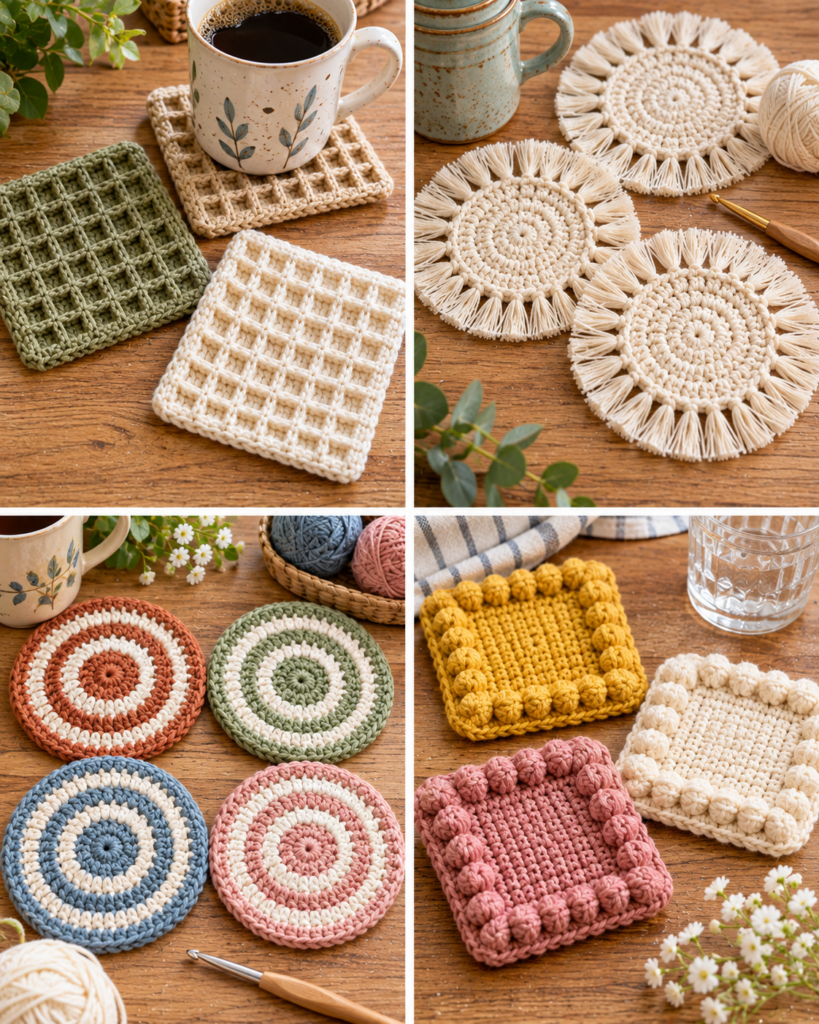
Coasters shine as gifts because they are useful and easy to bundle into a “finished” present. For giftable crochet coaster patterns, aim for consistency and thoughtful pairing.
Easy set ideas:
- Monochrome set: Same stitch, same color, finished with a clean border for a modern look.
- Seasonal set: Four coasters in holiday colors, same pattern so they feel cohesive.
- Scrap-buster set: Same base color with a different border color on each coaster.
- Mix-and-match texture set: All the same size, but rotate between waffle, moss stitch, and ribbing for a curated feel.
Packaging: Tie stacks with cotton twine or yarn, add a simple paper tag with care instructions, and include an extra coaster if you are using hand-dyed or potentially bleeding colors.
Care instructions to include: Machine wash cold or warm, gentle cycle, lay flat to dry for best shape. Coasters can go in the dryer on low, but expect slightly more shrinkage over time. If edges start to curl after months of use, a quick re-wet and flat dry usually resets them.
“I made a set of moss stitch coasters with cotton yarn as my first ‘real’ project. They came out flatter than I expected after blocking, and now I keep a stack on the coffee table. Making the second set was twice as fast because the stitch rhythm finally clicked.”
Common Mistakes and How to Fix Them
Even simple crochet coaster patterns can misbehave. Here are the most common issues and the fixes that actually work.
- Coaster is too small or too large: Change hook size first. One hook size up or down often adjusts diameter by a noticeable amount without rewriting the pattern. Also check if you are using the same yarn weight as intended.
- Edges look wavy: You likely added too many increases in round coasters, or too many stitches in corners for square coasters. Rip back one round and rework with fewer increases, evenly spaced.
- Coaster cups like a bowl: Too few increases or tension is too tight. Add an extra increase or switch to a larger hook. For dense single crochet, this is very common.
- Visible seam in joined rounds: Try working in a spiral for single crochet rounds, or use a “joined but shifted” method where you slip stitch and start the next round in the next stitch to stagger the join.
- Ends pop out after washing: Weave in longer tails. Aim for at least 3 passes through stitches in different directions. Cotton is smooth and needs secure weaving.
- Coaster feels too thin: Use a denser stitch (single crochet, moss stitch) or add a border round. You can also crochet with two strands held together for a thicker coaster, but it will use more yarn.
Durability note: Avoid very loose stitches if the coaster will be used daily. Frequent tugging and washing can stretch open fabric over time, especially in acrylic.
Frequently Asked Questions About Crochet Coaster Patterns: 15 Easy Designs
How much yarn per coaster?
Most coasters use 8 to 18 grams of worsted cotton, depending on size and stitch. A 4 inch single crochet coaster may use 10 to 12 g, while a 5 inch waffle stitch coaster may use 16 to 18 g. If you do not have a scale, measure by length: expect roughly 15 to 30 yards per coaster. Make one coaster first, then weigh it to calculate how many your yarn will make.
What stitch works best?
For everyday function, single crochet and moss stitch are the best balance of absorbency, stability, and ease. Single crochet makes a dense fabric that protects finishes and holds shape. Moss stitch (single crochet plus chain spaces) is forgiving, attractive, and lies flat easily. If you want extra thickness, waffle stitch is excellent, just plan for higher yarn use and a slightly longer crochet time.
Why do coasters curl?
Curling usually comes from tight tension, too few increases (in round coasters), or a border that is too tight. First, try a larger hook. Next, review your increase count and spacing. If the curling started after adding a border, redo the border with a looser tension, a bigger hook, or fewer stitches (especially around corners). Blocking also helps cotton relax, but it will not fix incorrect increases.
Can I use leftover yarn from other projects?
Yes, as long as the fiber content and weight are similar across the set. Mixing cotton and acrylic in the same stack can lead to uneven washing results and different absorbency. If you want a scrap look, keep all yarns cotton and close to the same thickness, then unify the set with the same border round.
What size should a coaster be for iced drinks? For iced coffee and wide glasses, make coasters 5 inches across or slightly larger. Condensation spreads, so a small 4 inch coaster may not catch drips. Use a dense stitch like moss stitch or single crochet and consider a simple border to keep edges from stretching when wet.
Do I need to block coasters? You do not have to, but blocking makes a noticeable difference in flatness and presentation, especially for gift sets. Cotton responds very well to wet blocking. If your coasters are already flat, you can skip pinning and simply dampen, smooth, and dry flat after weaving in ends.
How do I make all coasters the same size?
Use the same hook, yarn, and stitch count, and measure as you go. If you tend to crochet tighter or looser depending on the day, stop at a target diameter instead of a target round count. For example, end the coaster when it reaches 4.25 inches, then add the same border to each.
Are crocheted coasters safe for hot mugs?
Generally yes for warm to hot beverages in mugs, especially with cotton yarn and a moderately thick fabric. They are not a replacement for trivets or potholders. If you routinely use very hot ceramic or metal drinkware, choose thicker stitches (waffle, dense single crochet) and avoid synthetic yarns that can soften with heat.
How do I stop color bleeding in bright cotton?
Pre-wash the yarn skein if the label allows, or at least test-wash a small swatch. Wash finished coasters in cool water the first few times, and avoid soaking dark-and-light combinations together. If a coaster bleeds, rewash it alone and lay flat to dry. Cotton dye behavior varies by brand and color.
Final Thoughts
The best crochet coaster patterns are the ones that match how you actually live: cotton yarn for absorbency, a stitch that lies flat, and a size that fits your favorite cups. Start with one simple round or square coaster, then make a set of four to practice consistency. Add a border and block them once, and you will be surprised how professional they look. When you are ready for a natural next step, use the same yarn and skills to make matching crochet dishcloths or a small mug cozy. Pick one design from the list above, gather your cotton and hook, and make your first coaster today.